
Beauty Product Analyst & Content Editor · About the publication · Updated August 9, 2026
This eyebrow shapes guide starts with one rule: refine the brow you naturally have before trying to replace it. Face shape can suggest whether a softer, lifted, or straighter line may create balance, but your brow bone, hair direction, density, eye position, and preferred maintenance level matter just as much.
For most people, the best process is reversible. Use this eyebrow shapes guide to identify your face shape, map the start, arch, and tail, then use clear or tinted brow gel to test several directions before tweezing. This gives you a real preview in your own mirror, with your own features, instead of treating a face-shape chart as a strict rule.
Key Takeaways
- Oval faces usually suit a soft natural arch; round faces often benefit from gentle lift rather than a sharp peak.
- Square faces tend to suit a softly angled brow, while heart-shaped faces often look balanced with a moderate rounded arch.
- Long faces can gain visual width from a straighter line; diamond faces usually suit a curved, softly defined brow.
- Brow mapping locates useful anchors, but it should not force identical brows or override natural growth.
- Test natural, lifted, and straighter versions with brow gel before making a permanent shaping decision.
On This Page
Eyebrow Shapes Guide: Face Shape Is the Starting Point
This eyebrow shapes guide uses visual balance rather than rigid beauty rules. A lifted line adds vertical structure, a straighter line adds horizontal width, and a rounded arch can soften prominent angles. These are styling effects, not objective laws. Two people with the same face outline may need different brows because one has flat hair growth and the other has a clear natural peak.
A useful 2026 Vogue guide to eyebrow shapes reaches the same practical conclusion: professionals consider facial structure, natural hair, brow bone, density, lifestyle, and the look a person wants. That is why this guide uses face shape as filter one, natural anatomy as filter two, and a reversible brow-gel test as filter three.
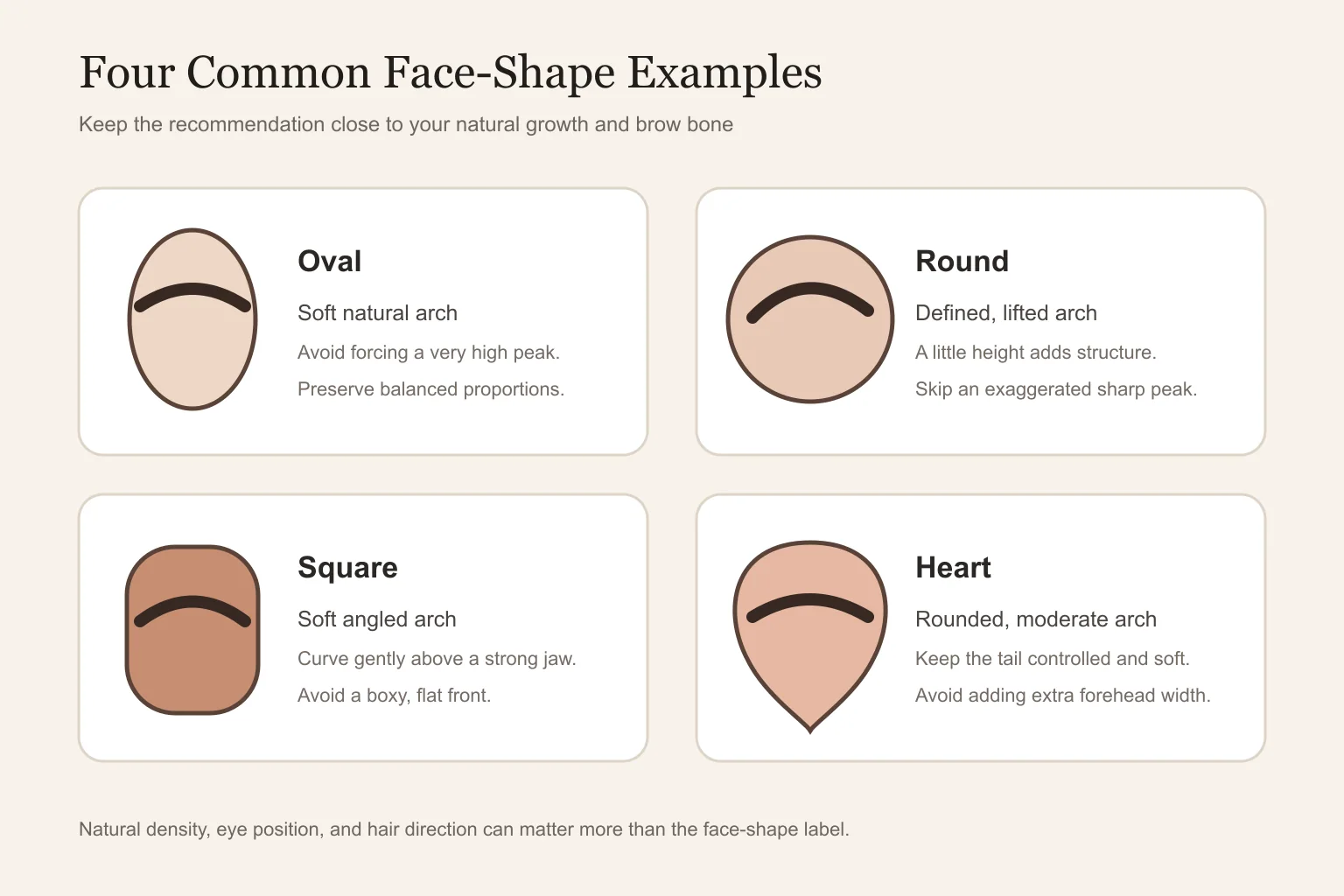
| Face shape | Good starting brow | Avoid forcing |
|---|---|---|
| Oval | Soft natural arch | A very high peak |
| Round | Defined, gently lifted arch | An exaggerated point |
| Square | Soft angled arch | A blocky, flat front |
| Heart | Rounded, moderate arch | A long, heavy tail |
| Long or oblong | Straighter, softly extended line | Extra vertical height |
| Diamond | Curved, softly defined arch | A severe angular peak |
Best Brow Shape for Oval Faces
The oval-face match in this eyebrow shapes guide is a soft natural arch. Oval proportions already read as balanced, so the aim is usually grooming and definition rather than dramatic correction. Keep the front airy, let the arch rise gently around the outer third, and taper the tail without dragging it downward.
If your growth is naturally straight, do not carve a peak just because a diagram says oval faces need an arch. Brush the center hairs slightly upward and the tail outward. A flexible clear brow gel may be enough. If gaps interrupt the line, a tinted or fiber formula can add visual continuity; see our guide to brow gel for sparse brows.
Best Brow Shape for Round Faces
The round-face match in this eyebrow shapes guide is a gently defined arch. The key word is gentle. Lift the hairs near the arch and direct the tail diagonally outward. This creates vertical structure without cutting a sharp triangle into the brow.
Avoid tracing a very round brow that repeats the face outline, but also avoid an extreme peak that looks disconnected from the brow bone. Test the difference with gel: style one photo in your natural direction, then another with the outer third lifted. Compare the full face, not a magnified eyebrow.
Best Brow Shape for Square Faces
The square-face match in this eyebrow shapes guide is a softly angled arch. It complements a strong jaw without competing with it. Preserve enough fullness to suit the facial structure, then soften the front and curve the transition into the tail. The result should look defined, not stamped.
A squared-off inner brow can make every line feel harder. Instead of filling the front as a rectangle, wipe excess product from the spoolie and use the lightest pressure there. Add hold through the arch and tail. If you are new to controlling pressure and direction, our beginner brow gel tutorial explains the basic motion.
Best Brow Shape for Heart-Shaped Faces
The heart-face match in this eyebrow shapes guide is a rounded, moderate arch. It can balance a wider forehead and narrower chin. Keep the curve soft and let the tail taper naturally toward the temple. A severe peak or an overextended tail can add visual weight to the upper face.
If your natural brow is angular, soften it with hair direction rather than removing the peak. Brush the front upward, the center diagonally, and the tail outward. That gradual combing motion produces a curve while preserving density.
Best Brow Shapes for Long and Diamond Faces
For long or oblong faces, this eyebrow shapes guide starts with a straighter brow and softly extended tail. The horizontal line adds visual width and avoids creating more height. Keep a small natural rise if your hair already grows that way; straight does not have to mean flat or heavy.
Diamond faces often suit a curved, softly defined arch. This can soften the angles around wider cheekbones. Avoid forcing a severe point. Follow the brow bone, keep the front light, and use the curve to connect the fuller center to a neat tail. This direction is also recommended in L’Oréal Paris’s face-shape brow guide.
Arched vs. Straight Brows: Which Is Right for You?
Choose an arched brow when you want lift; choose a straighter brow when you want width and a calmer horizontal line. Then check whether the shape agrees with your natural growth. A visible natural peak supports an arch. Flatter growth supports a straighter style with less daily effort.
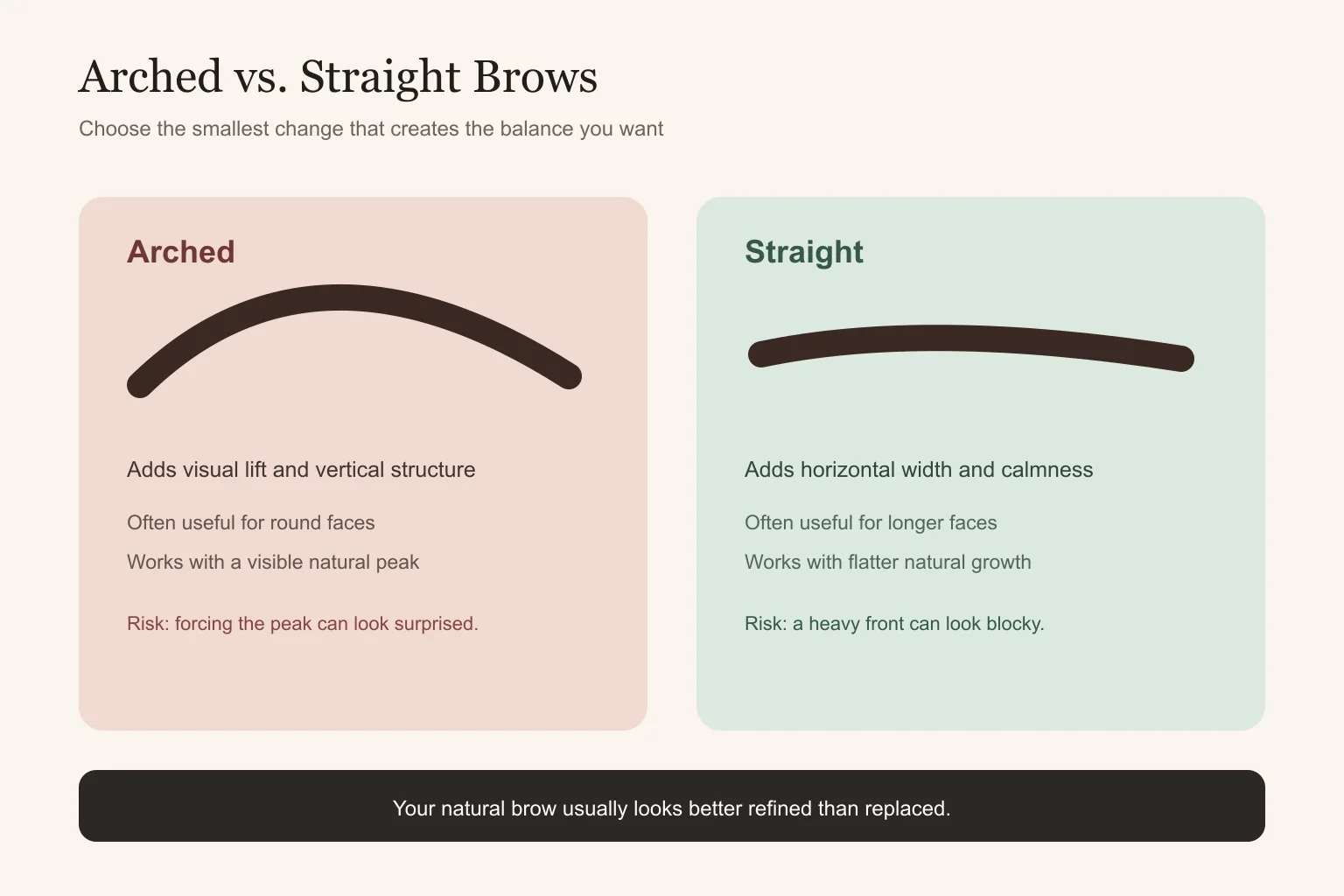
Also consider density. A thin, high arch creates a stronger visual effect than a full, softly angled brow. A wide, dark, perfectly straight front can look heavier than a straighter shape made from light individual hairs. Shape, thickness, color, and finish work together.
How to Map Your Own Brow Shape at Home
The mapping step in this eyebrow shapes guide uses three anchors to estimate where the brow starts, peaks, and ends. You need a mirror, a slim brow pencil or brush handle, and a washable pencil for tiny marks. The method is also explained in this step-by-step eyebrow mapping tutorial.
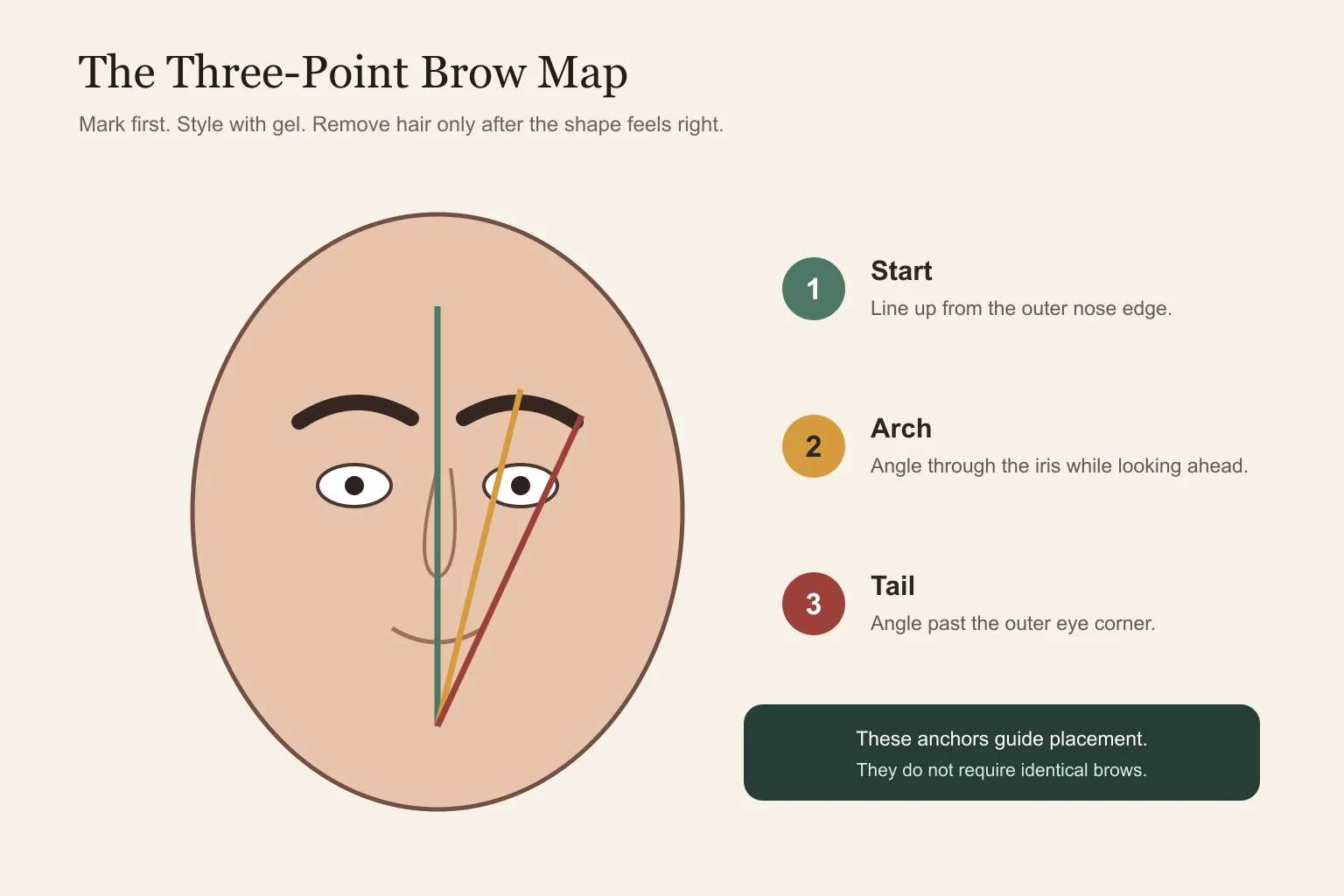
- Find the start. Hold the pencil vertically from the outer edge of the nostril toward the brow. Mark where it meets your natural hair.
- Find the arch. Keeping the lower end near the nostril, angle the pencil through the iris while looking straight ahead. Treat the intersection as an arch zone, not a single compulsory point.
- Find the tail. Angle the pencil from the nostril past the outer eye corner. Mark the intersection near the end of the brow.
- Connect lightly. Sketch the lower and upper boundaries with tiny strokes. Keep each line inside or very close to your existing growth.
- Step back. Judge balance from normal conversation distance. Small natural differences are expected; the goal is harmony, not duplication.
Do not tweeze immediately after drawing the map. Wear the proposed outline for a few hours, photograph it in daylight, and check the expression it creates. If you plan a major change, a brow professional can help preserve hairs that would be slow to regrow.
A Three-Photo Brow-Shape Test
Brow gel offers a reversible way to preview direction and silhouette without removing hair. Use the same lighting, camera distance, and facial expression for three photos. Clear gel isolates shape; tinted gel shows how added density changes the result.
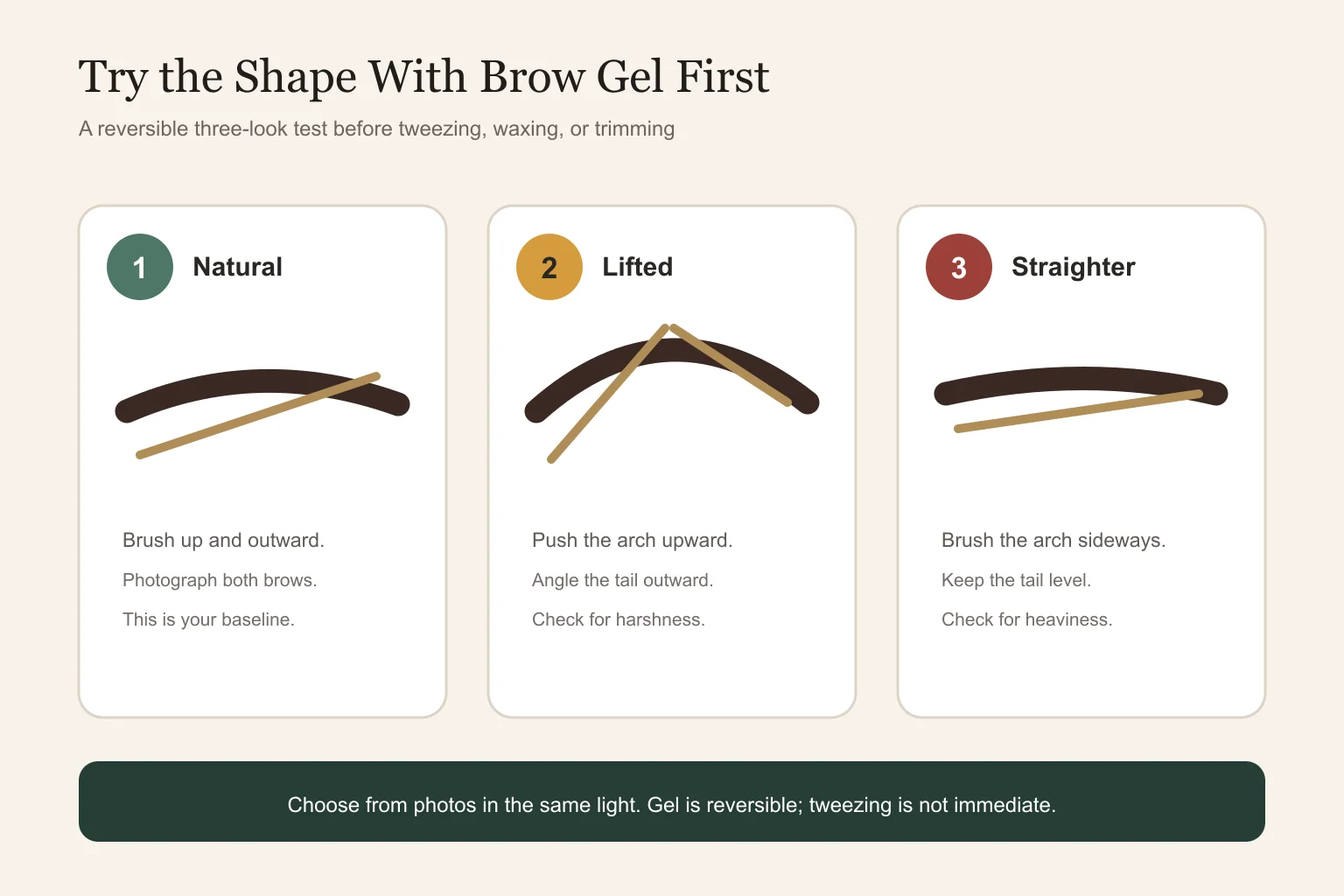
- Natural: brush up and outward along the existing growth. This is your baseline.
- Lifted: push the arch hairs upward and angle the tail outward. Check whether the result feels open or overly sharp.
- Straighter: brush the center and arch more sideways, keeping the tail level. Check whether the result feels balanced or heavy.
Choose from full-face photos, not memory. If one style only works with a maximum-hold gel and constant correction, decide whether that maintenance fits your routine. Keep this test focused on silhouette; our beginner application guide covers basic mechanics, while the advanced application guide covers finish and pressure.
2026 Brow Shape Trends Favor Flexibility
Teen Vogue’s 2026 trend report includes both straight and fluffy looks. That contrast supports a more flexible approach to shape selection rather than one compulsory brow for every face.
Test a straighter, softer, or more lifted silhouette before changing the hairline. Shape trends move quickly; preserving useful density gives you more choices when your preference changes.
Frequently Asked Questions
How do I find the best eyebrow shape for my face?
Identify the broad face shape, then check your brow bone, natural hair direction, density, and eye position. Map the start, arch, and tail, and test natural, lifted, and straighter versions with brow gel before removing hair.
What brow shape suits an oval face?
A soft natural arch usually preserves the balanced proportions of an oval face. Keep the front light and the outer-third lift gentle rather than forcing a dramatic peak.
What is the best eyebrow shape for a round face in 2026?
A softly defined, gently lifted arch can add vertical structure to a round face. Keep the peak connected to your natural brow bone and avoid an exaggerated point.
Should I have arched or straight eyebrows?
Choose an arch for more visual lift and a straighter shape for more horizontal width. Natural growth is the tie-breaker: a shape close to your existing direction usually looks more believable and takes less maintenance.
Can brow gel change my eyebrow shape?
Brow gel cannot change where hair grows, but it can redirect hairs, reveal or soften an arch, extend the visual tail, and alter the overall silhouette. That makes it useful for testing a shape before tweezing or trimming.
Do both eyebrows need to be perfectly symmetrical?
No. Aim for balanced start, arch, and tail placement while respecting natural differences in density and growth. Perfect duplication often requires overfilling one brow or removing useful hair from the other.
The three-filter rule
Start with face shape, respect natural growth and brow-bone placement, then test the idea with brow gel. If all three point in the same direction, you have found a shape that is flattering, believable, and practical to maintain.
Editorial method: Emma Colins compared current professional shape guidance, mapping instructions, and 2026 trend coverage, then organized the advice into a reversible three-filter process. Face-shape recommendations are styling suggestions, not fixed beauty rules. Read our methodology and editorial trust standards.