
Emma Colins
EyebrowGel Contributor · Updated August 5, 2026
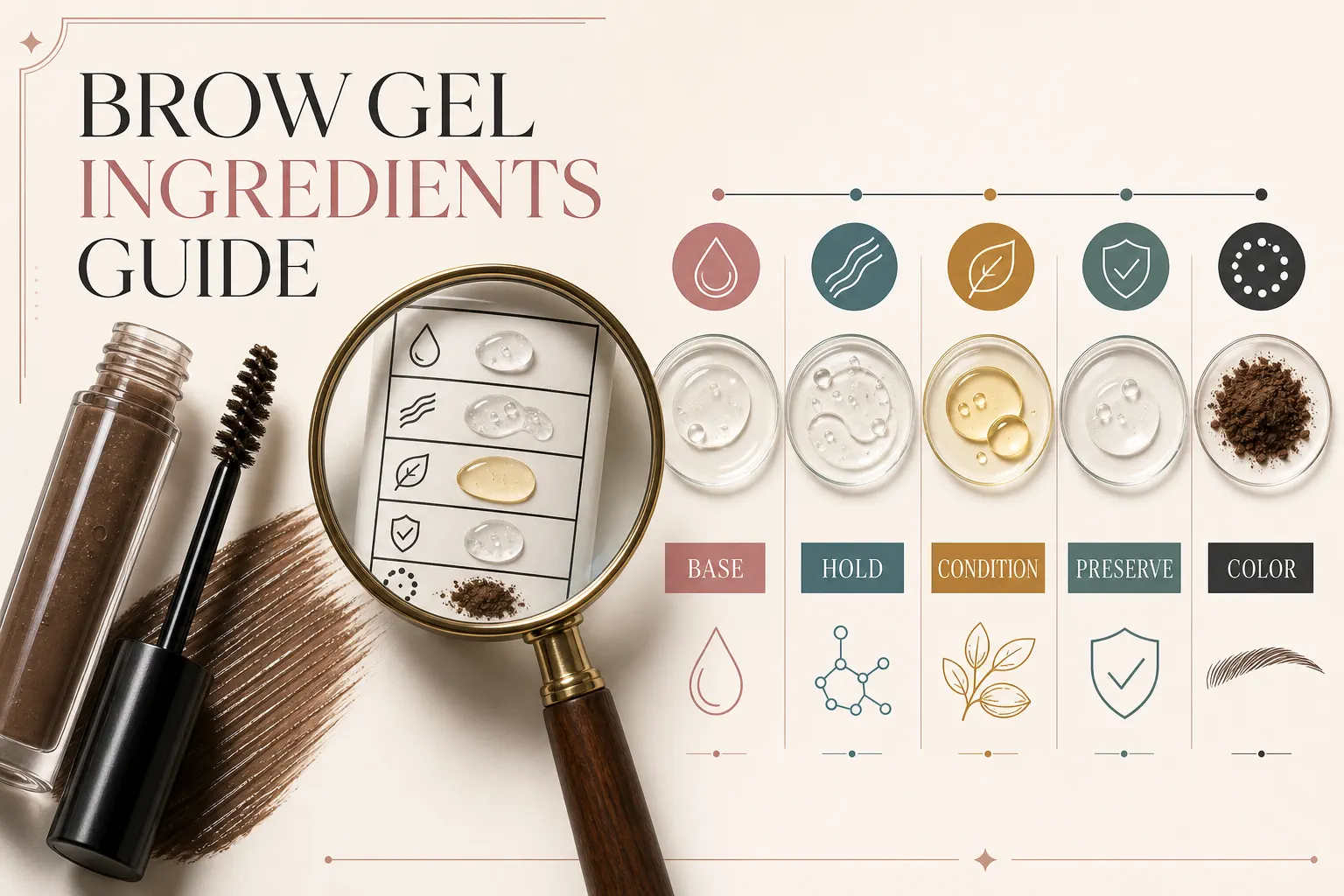
This brow gel ingredients guide is a practical ingredient glossary for the most common brow-gel formula terms. It explains what each ingredient actually does, what they cannot prove, and how to read an INCI list without being distracted by front-label promises. For a focused screening checklist, see bad ingredients in brow gel. A good ingredient list can help you predict hold, slip, finish, tint, and comfort, but it cannot tell you everything about wear without testing the finished formula.
If you have ever wondered what does PVP do in eyebrow gel, whether castor oil means growth, or why a clear gel can still feel different from another clear gel, you are asking the right questions. The useful answer is usually found in the relationship between ingredients, not in one fashionable ingredient.
For the styling basics first, read what eyebrow gel actually does, then return here to connect the visible result to the formula. Our best eyebrow gel guide covers product selection after you know what to look for on the label.
Key Takeaways
- Ingredient order gives clues about the formula, but it is not a performance ranking.
- PVP, VP/VA copolymer, and acrylates copolymers are film-formers that can help brow hairs stay in place.
- Glycerin, aloe, panthenol, oils, and vitamin E mainly affect feel and conditioning, not guaranteed hold.
- Biotin, peptides, and castor oil should not be treated as proof that a cosmetic brow gel will regrow hair.
- Preservatives are part of product safety in water-based formulas; “preservative-free” is not automatically better.
On This Page
Brow Gel Ingredients Guide: How to Read a Brow Gel Ingredient List
Use this ingredient glossary to connect each INCI name with its likely job in the finished brow gel.
Start with the first three to five ingredients, then look for the ingredients that explain the product promise. In the United States, cosmetic ingredients are generally listed in descending order of predominance. Ingredients present at 1% or less may be listed in any order after the higher-concentration ingredients, and color additives can appear separately. The FDA cosmetic ingredient naming guidance and its cosmetics labeling guide explain those conventions.
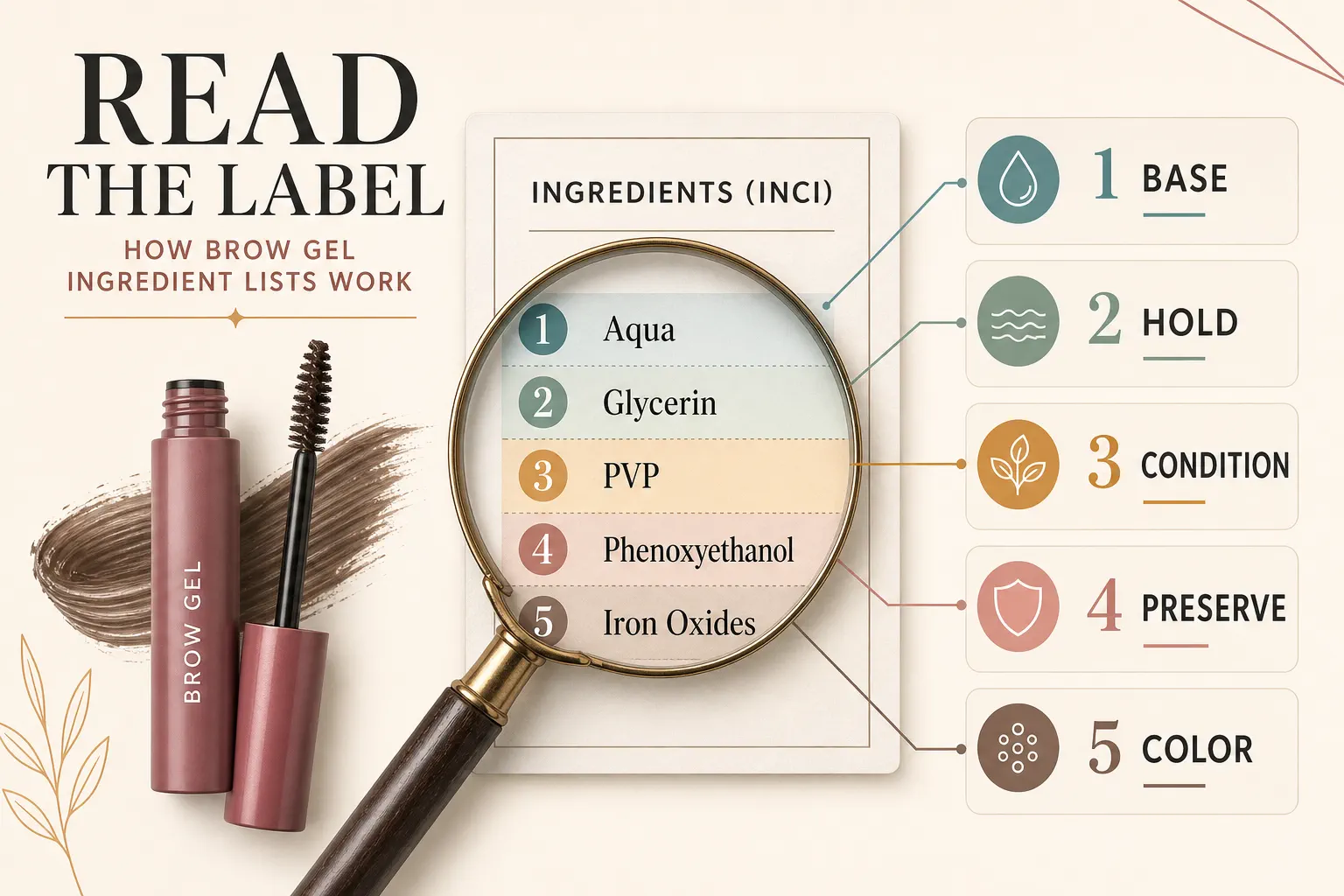
Brow gel ingredients guide takeaway: Start with function, then use ingredient order to compare formulas.
For example, a simplified illustration might begin with Aqua, Glycerin, and a film-former, followed by texture modifiers and a preservative system. That does not mean Glycerin is “better” than PVP or that the fourth ingredient is weak. It only tells you something about relative presence. The brow gel ingredients guide rule of thumb is to connect a claim to a function: “strong hold” should make you look for film-formers; “conditioning” points toward humectants, emollients, or soothing ingredients; “tinted” points toward pigments.
- Base and vehicle: water, solvents, and thickeners carry the formula and set its texture.
- Hold: polymers form a film around hair as the product dries.
- Conditioning: humectants and emollients change softness, flexibility, and slip.
- Stability: preservatives, chelators, buffers, and stabilizers help the product remain usable.
- Color: pigments and colorants create the visible tint, usually later in the list.
Brow Gel Ingredients Guide: Holding Polymers (PVP, VP/VA Copolymer)
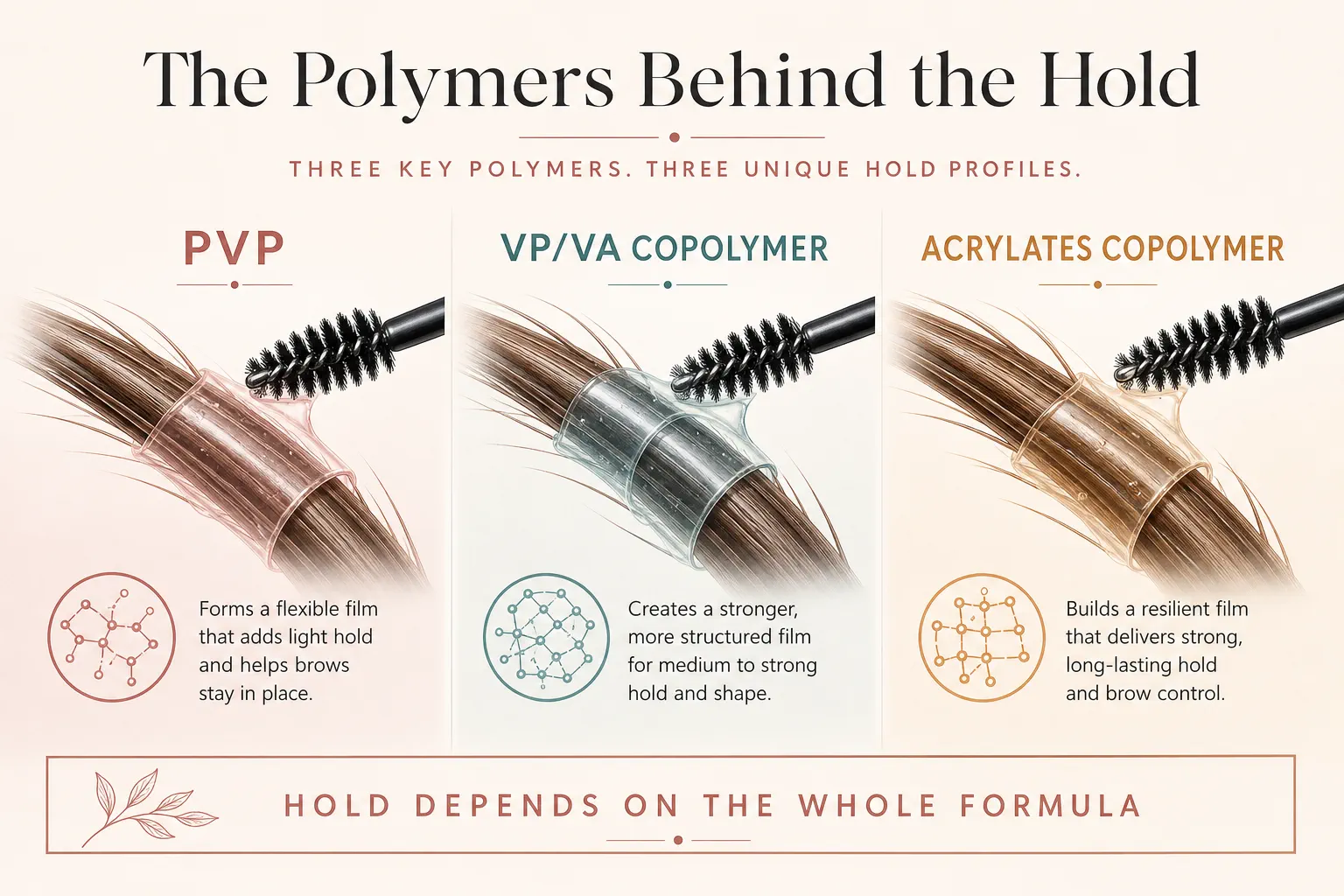
This ingredient glossary groups PVP and VP/VA copolymer as film formers that help brow hairs hold position.
Holding polymers are the reason a brow gel can set a brushed shape instead of simply making the hairs wet. As the water or volatile portion dries, a film-forming polymer remains on the hair. The film can add control, structure, and resistance to movement. Its real-world performance depends on the full formula, the amount applied, humidity, skin oils, brow texture, and how long you let it set.
| Ingredient family | What it can do | What it does not prove |
|---|---|---|
| PVP | Forms a film and helps hold hairs in position. | That the gel will resist every level of sweat or humidity. |
| VP/VA Copolymer | A film-former used to create structured hair hold. | A guaranteed crunchy, waterproof, or stronger result than every alternative. |
| Acrylates Copolymer | Can create a resilient film and help with styling control. | That the product will feel comfortable or invisible on every skin type. |
Brow gel ingredients guide takeaway: A film-former explains hold, but the whole formula explains the feel.
A useful brow gel ingredients guide does not label one polymer as universally best. PVP may suit a light, flexible style; a copolymer blend may create more structure; and a formula with several film-formers may feel stronger but less touchable. If you have oily skin, compare this ingredient section with our guide to eyebrow gel for oily skin. If the polymer film is applied over oil, even a promising formula can slide.
Brow Gel Ingredients Guide: Conditioning Ingredients (Glycerin, Aloe Vera)
In this ingredient glossary, glycerin and aloe belong to the conditioning group rather than the primary hold system.
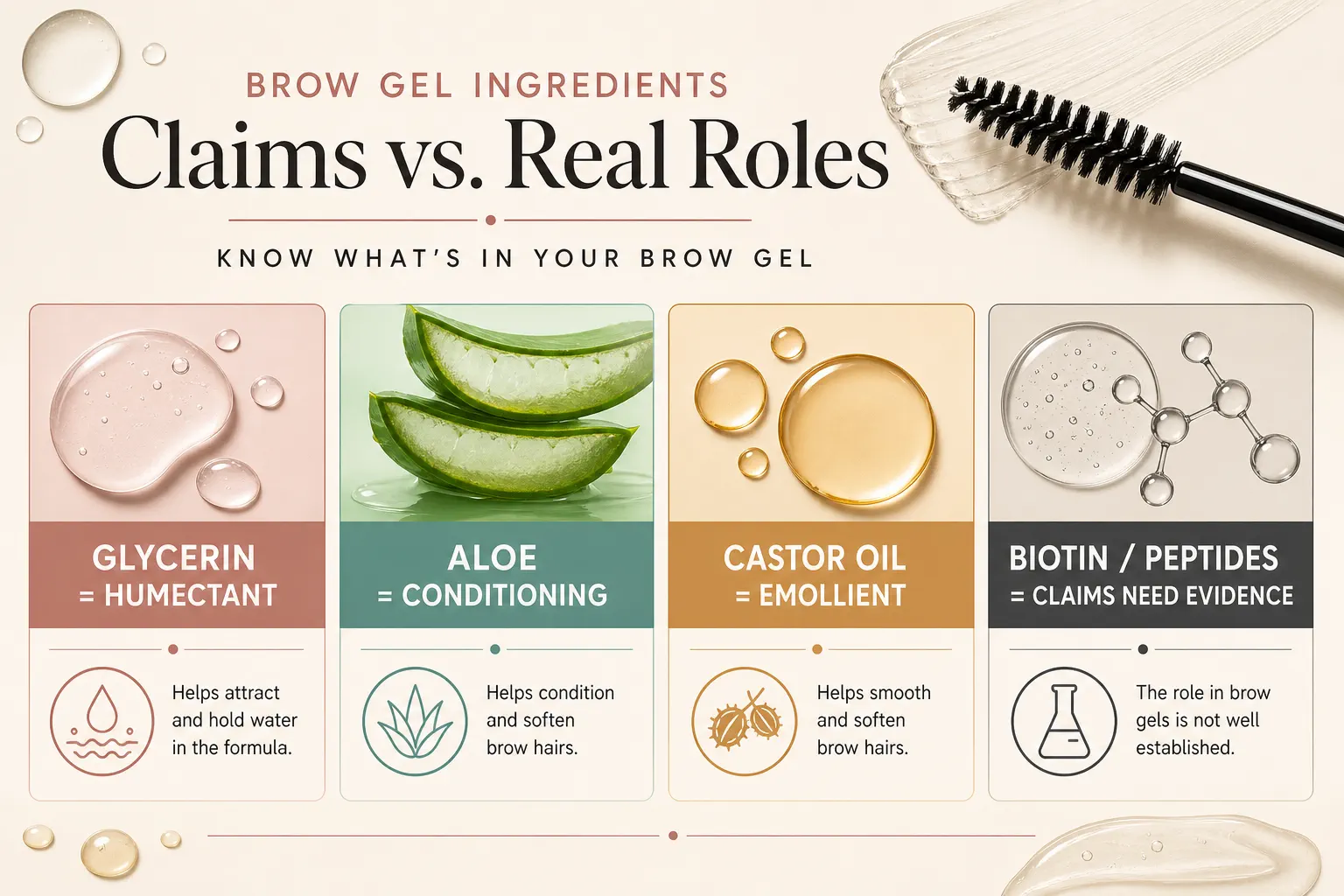
Conditioning ingredients mostly change how the formula feels on brow hair and skin. Glycerin is a humectant, meaning it helps attract and hold water within the formula. Aloe vera and panthenol are often used for a conditioned or comfortable feel. They can be helpful in a brow product, but they are not substitutes for the film-formers responsible for the main set.
Brow gel ingredients guide takeaway: Conditioning ingredients change comfort and slip; they are not the same as hold.
There is a tradeoff. A formula that feels very soft and emollient may be pleasant on dry brows but less crisp on oily skin. A lightweight clear gel may feel clean but give less flexibility after it dries. The right choice depends on whether your priority is softness, a natural finish, maximum hold, or a tint. Read our eyebrow gel for sensitive skin guide if fragrance, alcohol, or irritation is a concern.
Brow Gel Ingredients Guide: Growth-Support Ingredients (Biotin, Peptides)
The ingredient glossary separates marketing language from what biotin and peptides can realistically do in a rinse-off cosmetic.
Biotin and peptides attract attention because they sound like hair-care ingredients. In a cosmetic brow gel, their presence does not automatically mean the product can regrow sparse brows. Biotin is a B vitamin, and the NIH Office of Dietary Supplements fact sheet notes that there is limited scientific evidence for biotin supplements improving hair, skin, or nails in people who are not deficient. That is not the same as proving a topical brow gel works as a growth treatment.
Brow gel ingredients guide takeaway: Treat growth language as a claim that needs evidence, not as a formula fact.
Peptides are a broad family, not one single ingredient with one guaranteed result. A product can use them as a conditioning or marketing feature, but the evidence needs to match the exact peptide, concentration, delivery system, and claim. The practical rule in this brow gel ingredients guide is simple: treat biotin and peptides as potential formula extras unless the brand provides credible, product-specific evidence. For visible fullness, a tinted or fiber gel can change appearance immediately; that is a styling effect, not new growth.
Brow Gel Ingredients Guide: Natural Oils (Castor, Argan, Vitamin E)
This ingredient glossary treats oils as conditioning ingredients, not proof that a brow gel can create new hair growth.
Brow gel ingredients guide takeaway: Oils can condition brows, but slip may reduce crisp hold for some users.
Castor oil, argan oil, and tocopherol, also known as vitamin E, are generally included for emollience, softness, or a smoother feel. Oils can make brow hairs look glossy and flexible. They may also add slip, which is useful for dry or coarse brows but can work against a crisp set if too much is used or if the skin is already oily.
Castor oil in brow gel is therefore best understood as a conditioning or texture choice, not a promise of regrowth. “Natural” describes origin, not automatically safety, purity, or performance. A plant-derived ingredient can still irritate someone, and a synthetic ingredient can be carefully tested and well tolerated. Check the full formula, use a clean spoolie, and stop using a product if you develop burning, swelling, or persistent irritation.
Brow Gel Ingredients Guide: Colorants and Pigments
The ingredient glossary identifies pigments by function so you can distinguish tint from hold and conditioning ingredients.
Brow gel ingredients guide takeaway: Pigments change visible density and shade; they do not replace styling technique.
Tinted brow gels use colorants to add depth, definition, and sometimes the appearance of fuller brows. Common label entries include iron oxides, listed with CI numbers or names, and other approved pigments depending on the market. The pigment system affects undertone, opacity, transfer, and whether the gel looks natural or makeup-heavy.
A clear gel has no visible pigment, but it still has an ingredient system and still needs appropriate eye-area use. If a tinted gel looks too strong, wipe excess from the wand before touching the brow, use the spoolie to distribute color through the front, and avoid repeatedly layering over a wet patch. For a step-by-step routine, see how to use eyebrow gel.
Brow Gel Ingredients Guide: Preservatives – Safe vs. Problematic
This ingredient glossary explains preservatives by context, concentration, and personal sensitivity rather than using blanket fear labels.
Brow gel ingredients guide takeaway: A preservation system is a safety feature in a water-based eye-area product.
Most brow gels contain water, so the formula needs a preservation system to control microbial growth during normal use. You may see ingredients such as phenoxyethanol, ethylhexylglycerin, sodium benzoate, or potassium sorbate. Other ingredients, such as citric acid or chelators, can help with pH or stability. A preservative is not a flaw; an under-preserved eye-area product can create a more serious safety concern.
The word “problematic” depends on dose, exposure, and the person using the product. Fragrance and essential oils may be more relevant to someone with a fragrance sensitivity than to someone who has never reacted. Parabens are often discussed in marketing, but “paraben-free” alone does not establish that a product is safer or gentler. Follow the package instructions, do not share eye cosmetics, and replace a product that changes smell, color, or texture. The FDA eye cosmetic safety guidance is a useful reference for everyday habits.
Brow Gel Ingredients Guide: Full Ingredient Glossary A-Z
The complete ingredient glossary below provides a quick reference for more than 20 recurring brow-gel label terms.
Brow gel ingredients guide takeaway: Use the glossary to translate a label, then judge the finished product by wear and comfort.
Use this quick glossary to translate common label terms. Ingredient functions can overlap, and the same ingredient can behave differently depending on the finished formula.
| Ingredient | Plain-English role | Do not assume |
|---|---|---|
| Aqua | Water-based vehicle. | It predicts hold by itself. |
| Aloe Barbadensis Leaf Juice | Conditioning or soothing support. | It guarantees irritation-free wear. |
| Argania Spinosa Kernel Oil | Emollient oil for softness and slip. | It makes every gel long-wearing. |
| Biotin | A B-vitamin used as a formula or marketing feature. | It proves brow regrowth. |
| Carbomer | Thickener and gel-structure builder. | It is the main hold polymer. |
| Castor Oil | Emollient that can add softness and shine. | It is a proven topical growth treatment. |
| Citric Acid | pH adjuster or buffer. | It exfoliates the brow in a gel. |
| Ethylhexylglycerin | Preservative booster and deodorant ingredient. | It is the only preservative in every formula. |
| Glycerin | Humectant that helps retain water. | It replaces a film-former. |
| Iron Oxides | Tint and shade adjustment. | More pigment always looks more natural. |
| Panthenol | Pro-vitamin B5 used for conditioning. | It creates strong set on its own. |
| Parfum / Fragrance | Scent. | A pleasant scent means better eye-area tolerance. |
| Peptides | A broad family used for conditioning or targeted claims. | Every peptide has the same evidence. |
| Phenoxyethanol | Common preservative. | Its presence alone tells you the product is harsh. |
| PVP | Film-former and hair-fixative polymer. | It guarantees waterproof wear. |
| Sodium Benzoate | Preservative used in suitable formulas. | It works the same at every pH. |
| Tocopherol | Vitamin E; antioxidant or conditioning support. | It is a brow-growth guarantee. |
| VP/VA Copolymer | Film-former for structured hold. | It determines the entire feel of the gel. |
| Xanthan Gum | Texture and viscosity modifier. | It is a styling adhesive. |
Frequently Asked Questions
These ingredient glossary answers address common misunderstandings about polymers, oils, biotin, pigments, and natural formulas.
What does PVP do in eyebrow gel?
Within the ingredient glossary, PVP is categorized as a hold polymer that forms a lightweight film around brow hairs.
PVP is a film-forming polymer that can help hold brow hairs in the direction set by the spoolie. The finished formula, amount applied, and environment determine whether the result feels flexible or firm.
What are the best ingredients in brow gel?
There is no universal best list. Look for a hold polymer if you need set, conditioning ingredients if your brows feel dry, pigments if you want definition, and a complete preservative system in a water-based product. Match the formula to your brow and skin type rather than chasing one ingredient.
Does biotin make brow hair grow?
Biotin in a cosmetic does not prove that the product will grow brow hair. Treat growth language carefully and look for evidence tied to the exact finished product. A tinted or fiber gel can make brows look fuller immediately, but that is visual styling.
Are natural brow gel ingredients safer?
The ingredient glossary does not treat natural as automatically safer because plant-derived materials can also irritate sensitive users.
Not automatically. Safety depends on the ingredient, concentration, formula, exposure, and your own sensitivity. “Natural” and “synthetic” are origin descriptions, not a complete safety rating.
Can castor oil replace brow gel?
Castor oil may soften and add shine, but it does not provide the same predictable styling film as a brow gel. It can also feel slippery, especially on oily skin. If you want shape and hold, use a product designed for that job.
A practical final check
When comparing two products, ask four questions: what creates the hold, what changes the feel, what adds color, and how is the water-based formula preserved? That simple framework is more useful than choosing a product because one ingredient sounds impressive.
Ingredient lists and cosmetic formulas can change. Always check the packaging for the current formula, follow the product directions, and patch test if you are prone to reactions. This guide is educational and is not medical advice.
Compare real formulas
See the brow gel formula database for eight current products compared by hold system, fragrance disclosure, claim evidence, and verification date.