
Emma Colins
EyebrowGel Contributor · Updated August 3, 2026
The best starting point when choosing eyebrow gel for sensitive skin is a fragrance-free formula with a complete ingredient list, a controllable spoolie, and no ingredient you already know causes a reaction. “Hypoallergenic,” “natural,” and “paraben-free” do not prove that a brow gel will suit you. Read the label, test the complete formula on a small area away from the eyes for 7 to 10 days, and keep the first brow application light and mostly on the hair.
This guide gives you a repeatable way to evaluate claims, ingredients, and skin contact. If you are comparing products more broadly, begin with our best eyebrow gel guide, then use the checks below to decide which formulas deserve a careful trial.
Key Takeaways
- Start with your own history: avoid ingredients linked to a previous repeat reaction or identified by a clinician.
- Prefer fragrance-free to unscented: unscented products may still use fragrance-related ingredients to mask odor.
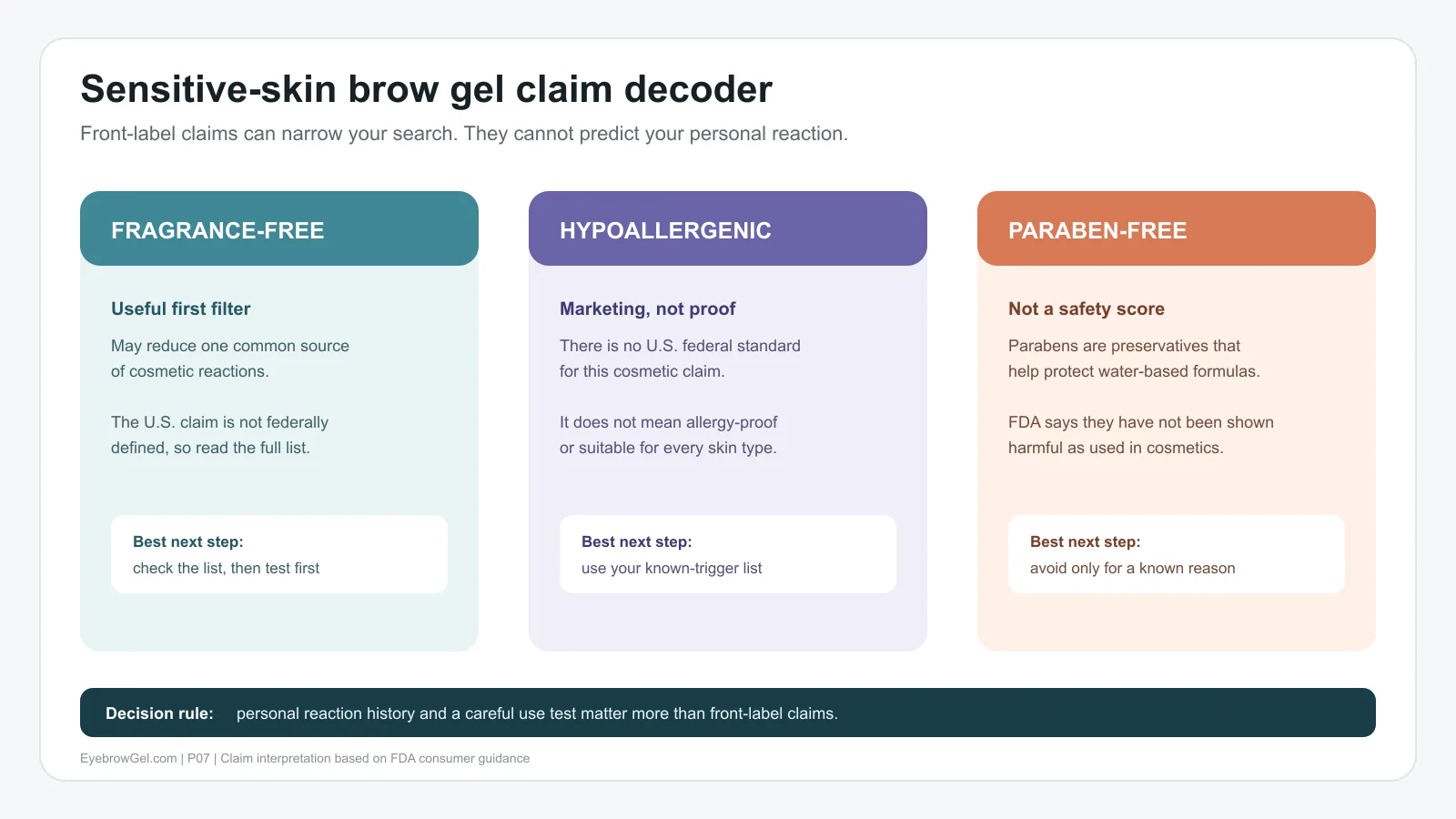
- Do not treat marketing as proof: the FDA says U.S. cosmetic terms such as “hypoallergenic” and “for sensitive skin” have no federal standard or definition.
- Do not fear preservatives as a category: water-based brow gels need protection from microbial growth, and paraben-free is not a universal safety advantage.
- Test before brow use: the American Academy of Dermatology recommends testing cosmetics on a small arm area twice daily for 7 to 10 days.
Safety note: This educational guide has not been medically reviewed and cannot diagnose an allergy or eczema. Do not experiment on active, cracked, swollen, or weeping skin around the brows or eyelids. Ask a dermatologist for personalized guidance if reactions recur or the eye area is involved.
On This Page
Why Eyebrow Gel for Sensitive Skin Can Still Cause a Reaction
A reaction to brow gel is not always an allergy. Irritant contact dermatitis happens when a substance or repeated exposure damages or aggravates the skin barrier. Allergic contact dermatitis involves an immune response to a specific allergen after sensitization. The two can look similar at home, so redness or itching alone cannot tell you which process is happening.
DermNet’s overview of cosmetic contact reactions explains that fragrance and preservatives are important cosmetic-allergy categories, while any cosmetic constituent has the potential to cause a reaction in an individual. It also notes that a cosmetic allergy can develop after years of using a product without an earlier problem. That is why a label can guide selection but cannot diagnose compatibility.
The brow area adds an exposure problem
Brow gel is meant for hair, but a large or overloaded spoolie can press formula onto the brow bone. The skin near the eyes is also easy to touch while blending concealer, sunscreen, primer, and brow products. A reaction may come from the gel, another product underneath it, a dirty tool, or the combination. Change one product at a time when you are trying to identify a pattern.
Ingredients to Avoid in Eyebrow Gel for Sensitive Skin
The safest avoid list is personal, not universal. Start with exact ingredients that appeared in more than one product that caused the same reaction, or allergens identified through medical patch testing. If you do not have that history, use the categories below as questions to investigate, not a reason to reject every formula that contains them.
Fragrance, parfum, and masking scents
Fragrance-free is a sensible first filter for reactive skin. The FDA’s fragrance guidance says some people may be allergic or sensitive to components of fragrance formulas and notes that individual components may be listed simply as “fragrance” or “perfume.” The AAD also warns that “unscented” and some plant-based products can still include fragrance-related ingredients.
Botanical extracts and essential oils
A plant origin does not make an ingredient inert or allergy-proof. Rose water, citrus extracts, lavender, propolis, and other botanicals can be pleasant additions, but they add variables for a person who is already trying to isolate a trigger. If you have a history of fragrance or botanical reactions, a simpler fragrance-free formula may be easier to evaluate.
Preservatives you have reacted to before
Preservatives protect water-containing formulas from bacterial and fungal growth. They are necessary context, not a category to fear. If medical patch testing has identified a specific preservative allergy, compare the exact name and related names with the ingredient list. Without that history, do not assume an unpreserved or “clean” product is safer.
Quick-drying alcohols when they sting your skin
Alcohol denat. or ethanol can help a formula dry quickly, but a compromised skin barrier may sting when exposed to them. That does not mean every alcohol-containing brow gel is unsafe, and fatty alcohols such as cetyl or cetearyl alcohol are chemically and functionally different. Treat “alcohol-free” as a preference based on your experience, not a universal sensitive-skin rule.
Ingredients and Formula Clues for Reactive Brows
A good eyebrow gel for sensitive skin is easy to audit and easy to apply without coating the skin. No single ingredient guarantees gentleness. Look for a combination of transparent labeling, a fragrance-free position, a suitable hold system, and controlled application.
| Formula clue | Why it may help | What it cannot prove |
|---|---|---|
| Fragrance-free | Removes one important reaction category from consideration | That every remaining ingredient suits you |
| Complete ingredient list | Lets you compare exact names with your known triggers | Concentration or finished-formula behavior |
| PVP, VP/VA, or acrylates copolymer | Signals a film-forming hold system | Comfort or allergy safety for every user |
| Glycerin or panthenol | Can support a less brittle formula feel | That the full formula will not irritate |
| Small, precise spoolie | Helps keep product on hair instead of skin | Ingredient compatibility |
Product pages can show how brands frame these clues. Clinique’s Just Browsing Clear Sculpting Gel is positioned as fragrance-free, allergy tested, and safe for sensitive eyes. NARS Brow Shaping Gel publishes a short clear-gel ingredient list and an ophthalmologist-tested claim. These are useful screening details, not independent proof that either formula will suit a particular reader.
How to Read the Label on Eyebrow Gel for Sensitive Skin
Use three passes. First, search for exact known triggers. Second, understand the formula context rather than counting “free-from” claims. Third, check how much skin contact the package and applicator are likely to create.
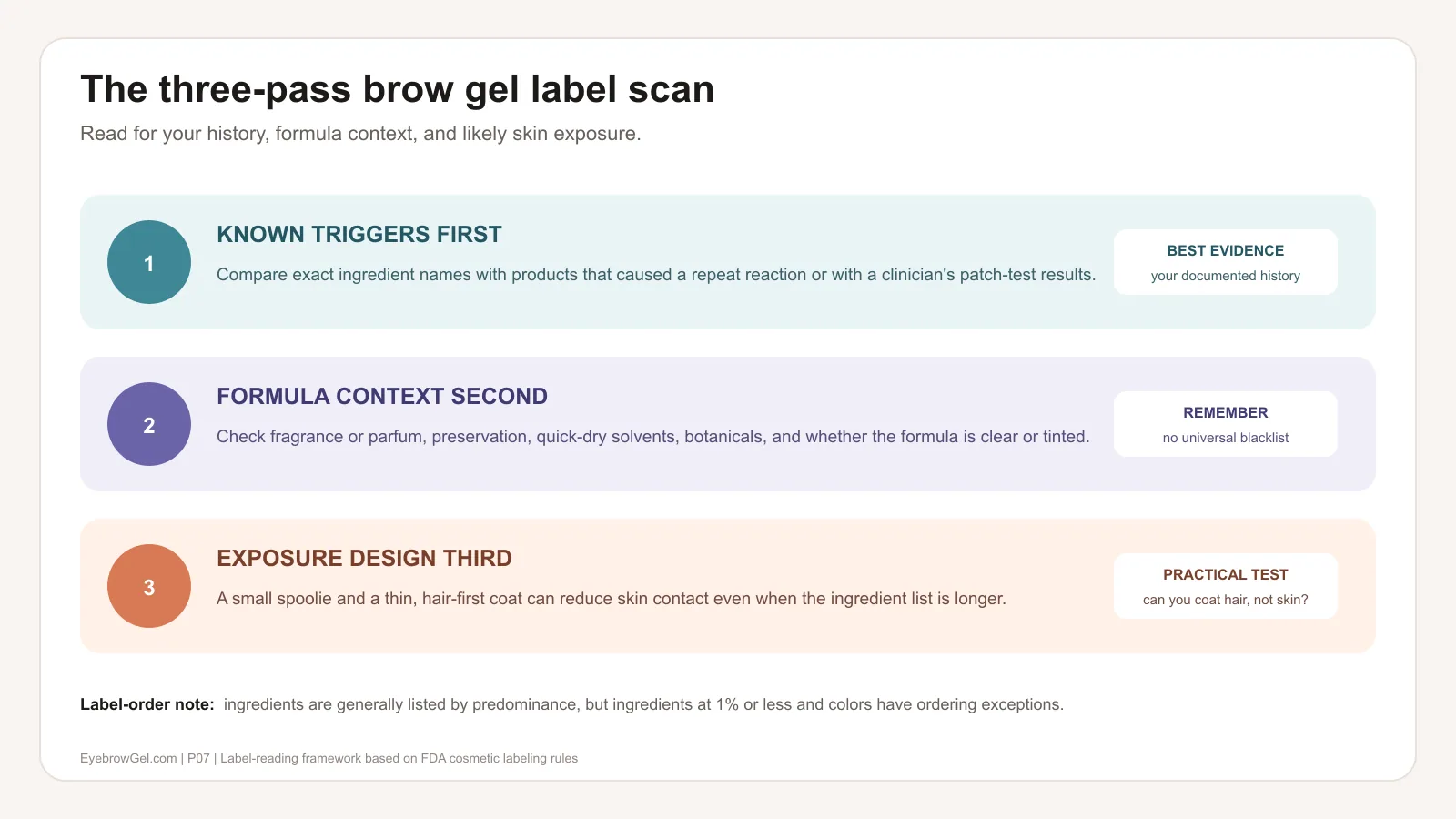
- Search the exact names you already avoid: save a note or photo of the ingredient list from products that caused a reaction. Compare patterns, but do not diagnose the culprit from one product alone.
- Check fragrance language: look for fragrance, parfum, perfume, aroma, and any botanical that you already know is a trigger. Prefer “fragrance-free” over “unscented” when fragrance is a concern.
- Identify the formula’s jobs: water is the base in many gels, film-formers provide hold, thickeners create gel texture, and preservatives protect the product. A longer list is not automatically worse if each component has a purpose.
- Compare clear and tinted versions separately: shade formulas can have different color additives or supporting ingredients. Do not assume the clear and brown versions share an identical list.
- Check the current package: brands reformulate. Use the list on the product you will apply, not an old screenshot or a third-party database alone.
The FDA’s cosmetic labeling summary says ingredients are generally listed in descending order of predominance. Ingredients at 1% or less and color additives have ordering exceptions, so the bottom of the list is not a precise concentration chart. Use order as context, not a dose calculation.
A Safer Way to Test a New Brow Gel
Test the finished brow gel, not just one ingredient. The American Academy of Dermatology’s home-testing guidance recommends a quarter-sized spot on the underside of the arm or bend of the elbow, using the normal amount twice daily for 7 to 10 days. Do not use the eyelid or eyebrow as the test site.
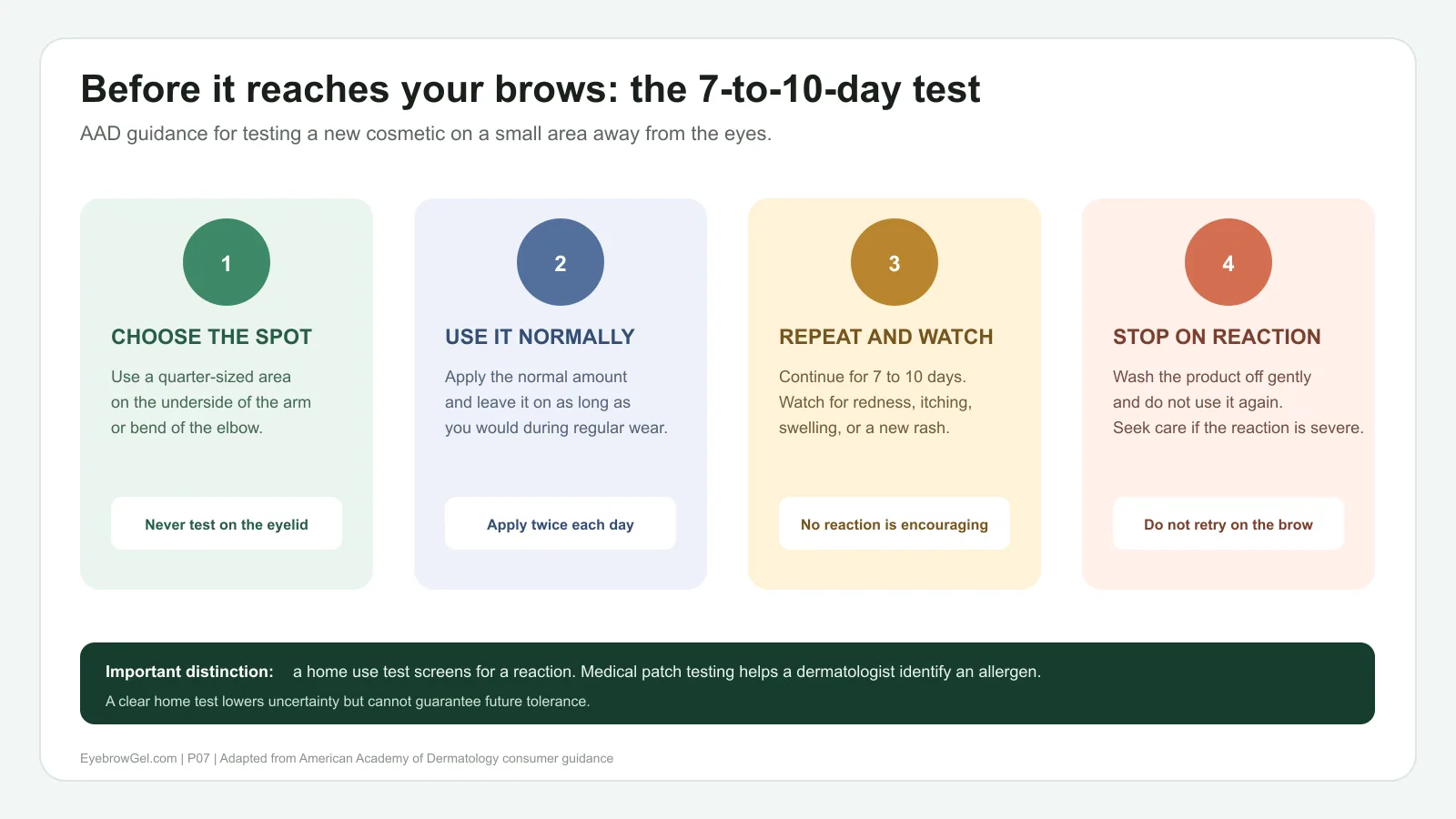
- Choose a small arm area: use the underside of the arm or bend of the elbow where the product will not be rubbed away.
- Use the normal amount: apply the amount and thickness you expect to use, then leave it on for the normal wear period.
- Repeat twice daily: continue for 7 to 10 days and watch for redness, itching, swelling, or a new rash.
- Stop if a reaction appears: gently wash the product off and do not use it on the brows. The AAD advises seeking dermatology care when a reaction is severe or difficult to identify.
A home use test is not medical patch testing. It can reveal that the complete product causes a problem on the test area, but it cannot name the responsible ingredient or guarantee that the eye area will tolerate it. Medical patch testing is selected and interpreted by a clinician when allergic contact dermatitis is suspected.
Application Tips for Reactive Brow Skin
Once a new eyebrow gel for sensitive skin passes your home test, reduce unnecessary exposure during the first brow application. A precise routine also helps you distinguish a formula problem from friction, dirty tools, or layered skincare.
- Wait for calm skin: do not apply over an active rash, broken skin, fresh waxing irritation, or a scratched brow bone.
- Start clean and dry: remove old makeup gently and let the brow hair dry. Avoid scrubbing the skin.
- Wipe excess from the spoolie: a thin coat reduces transfer onto the brow bone and is easier to remove.
- Coat hair before skin: use the side of the spoolie through the hair and avoid pressing the wand flat against the brow bone.
- Use one new product at a time: do not introduce a new primer, brow pencil, remover, and gel on the same day.
- Remove without friction: soften the gel with your usual tolerated remover, then wipe gently in the hair-growth direction.
- Keep the tool clean: do not share brow products. Follow the package-after-opening symbol and replace a product if its odor, color, or texture changes.
If the brow area is oily as well as reactive, do not compensate with aggressive cleansing. Our eyebrow gel for oily skin guide explains how to blot the skin and keep product on the hair without over-drying the area. If the goal is to cover bare patches, our eyebrow gel guide for sparse brows explains when a pencil or pen is more useful than extra gel.
See Also: Best Brow Gels for Sensitive Skin
This page is the ingredient and safe-use guide, not a product ranking. That separation protects the search intent: use this page to define your filters, then use a roundup to compare price, hold, shade, and applicator. A dedicated eyebrow gel for sensitive skin roundup should rank products by verified label details and applicator control, not by “clean” marketing alone. Until that roundup is live, compare clear and tinted formats in the best eyebrow gel guide and use the long-lasting eyebrow gel guide when hold is the second priority.
Frequently Asked Questions
What should I look for in eyebrow gel for sensitive skin?
Start with fragrance-free labeling, a complete current ingredient list, no known personal allergens, and a small controllable spoolie. Then test the finished formula on the underside of the arm or bend of the elbow before using it near the brows.
Does hypoallergenic mean a brow gel cannot cause an allergy?
No. The FDA says there is no federal standard or definition governing the term “hypoallergenic” for cosmetics in the United States. Treat it as a brand claim, then check the ingredient list and your own reaction history.
Is fragrance-free the same as unscented?
Not necessarily. An unscented product may use fragrance-related ingredients to mask the smell of other ingredients. Fragrance-free is the more useful starting filter when fragrance is a concern, but the FDA notes that the term itself is not federally defined for cosmetics.
Is alcohol-free brow gel always better for sensitive skin?
No. Quick-drying alcohols may sting some compromised skin, but tolerance depends on the whole formula and the person. Fatty alcohols such as cetyl or cetearyl alcohol are different ingredients. Use “alcohol-free” as a personal filter only when it matches your experience or clinical advice.
Should I choose brow gel without parabens?
Paraben-free is not automatically safer. The FDA says parabens have not been shown to be harmful as used in cosmetics, where they help prevent potentially harmful microbial growth. Avoid a specific paraben if it is a known trigger for you, not because the category is popular to exclude.
Can I use eyebrow gel when I have eczema around my brows?
Do not apply a new cosmetic to active, cracked, swollen, or weeping skin. Eczema around the eyes and brows deserves individualized advice because irritation, allergy, and the underlying condition can overlap. Ask a dermatologist before introducing a new brow product during a flare.
Does a clear home test guarantee the brow gel is safe near my eyes?
No. A clear 7-to-10-day test reduces uncertainty, but it cannot guarantee future tolerance or predict every eye-area reaction. Keep the first brow application light, avoid the eyelid and waterline, and stop using the product if symptoms appear.
The best rule
Claims narrow the shelf; your ingredient history and a careful use test make the decision. Choose a fragrance-free eyebrow gel for sensitive skin, avoid your known triggers, keep the spoolie on the hair, and stop at the first sign of a reaction.
Medical and regulatory source pages were checked August 3, 2026. Cosmetic formulas and labels can change, so confirm the current package before use.